


WPT Technology
Advances in thermochemical processes and molecular control enable the development of methods capable of treating materials at a structural level, not only mechanically or through combustion. Within this technological framework emerges controlled molecular disintegration - a process that acts on the bonds between molecules, facilitating the conversion of matter into a stable and usable energy form. Waste Power Tech develops and applies this method as an integrated technological infrastructure, positioning itself at the intersection of waste management and energy production.
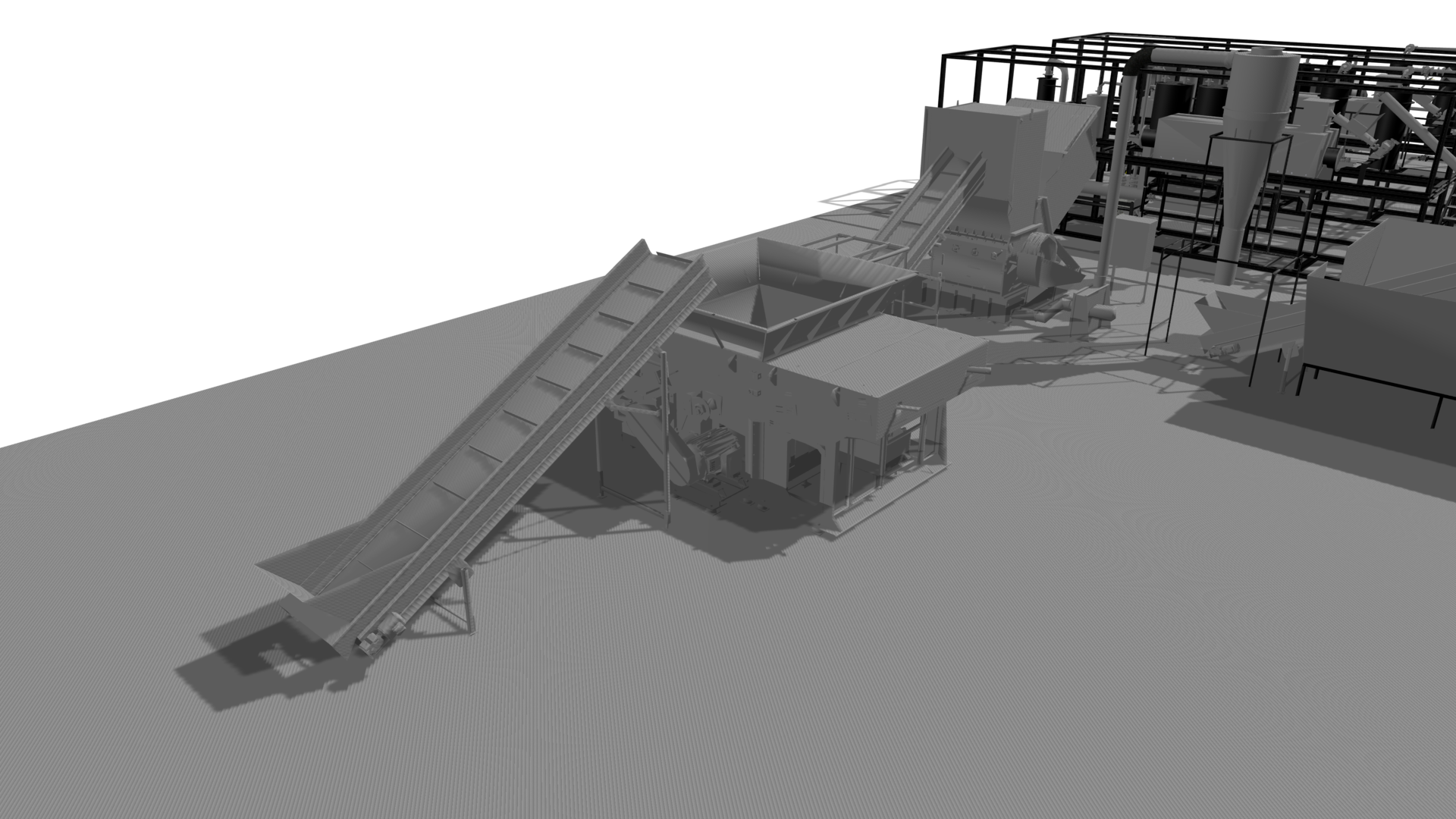
Explore Our 3D Process Model
Walk through each stage of our waste-to-energy solution in an interactive 3D environment. Scroll to move between sections.

01 / 08
Modern waste management and energy production can no longer be approached through one-dimensional solutions. Technology plays a crucial role in creating integrated systems capable of addressing material efficiency, environmental impact, and economic viability simultaneously. Without robust technological solutions, waste remains a logistical problem, and energy becomes a pressure point on existing infrastructure. Classical treatment technologies - whether landfilling, incineration, or anaerobic digestion - have clear limitations regarding energy efficiency, emission control, or the types of materials they can process. Especially for mixed, contaminated, or hard-to-recycle fractions, an approach that intervenes at the chemical level is required, not just mechanical or biological.
02 / 08
Molecular disintegration - the technological principle
WPT technology is based on a controlled thermochemical process of molecular disintegration of organic materials. The process takes place in a controlled environment, without direct combustion and in the absence of oxygen, avoiding the classical incineration mechanism. Molecular disintegration addresses this need through a controlled thermochemical process that converts the organic fraction of waste into energy-usable synthesis gas. The approach does not aim for simple volumetric reduction, but for the controlled conversion of the chemical energy contained in the material. Through automation, continuous monitoring, and modular architecture, the technology enables integration into an existing energy system, providing operational predictability and adaptability to variable material streams.
03 / 08
Why Molecular Disintegration?
Because the waste problem can no longer be solved only at the mechanical level. Traditional recycling works through sorting, shredding, and physical reuse. But a large portion of today’s waste — mixed, contaminated, composite — can no longer be efficiently recovered through classical methods. It ends up in landfills or is incinerated. Molecular disintegration goes to the fundamental level of matter. Instead of trying to reuse the object, the process breaks down the chemical structure of the material into elemental components (synthetic gases, energetic fractions, reusable compounds). Practically, we no longer treat the form of the waste, but its composition. It is a conversion approach, not a disposal method. Through the controlled breaking of molecular bonds, waste becomes an energy resource or a secondary raw material. This way we: reduce the volume sent to landfills, avoid direct burning, recover energy in a controlled way, and reduce dependence on primary fossil resources.
04 / 08
What is molecular disintegration?
A controlled technological process through which the complex organic structures in waste are broken down into simpler compounds, without direct combustion.
What happens, essentially?

The material is introduced into a controlled environment

Thermal parameters are stabilized

Molecular bonds are fragmented

A combustible gas (Syngas) is produced
05 / 08
What happens to the resulting gas?

It is collected from the reactor and cooled

Filtered from particles

Stabilized in flow and pressure

Used in an engine that produces electric energy
After the molecular disintegration process, the resulting gas is collected from the reactor, cooled, and filtered to remove residual particles, then stabilized in terms of flow and pressure. In this controlled form, it is used to power a cogeneration engine that converts the combustible gases into electric energy. The electricity produced is injected into the national grid and distributed to consumers - whether cities, public infrastructure, or industrial operators - thus integrating the treated waste into the real energy circuit.
06 / 08
What remains after the process?
The process reduces the organic fraction to synthesis gas and stabilizes the mineral component of the waste. The result is an inert material with potential for reuse in industrial and infrastructure applications, significantly reducing the amount sent to landfilling.
WASTE
80-90% energy
5-10% reusable mineral aggregate
recovered metals
07 / 08
What is the physical configuration of the installation?
The WPT installation is built in a modular configuration and includes the reception and storage area, the molecular-disintegration reactor, the gas cooling and conditioning systems, the cogeneration unit, and the mineral-residue handling line. For a detailed presentation of the installation's configuration watch the explanatory video material.
Installation explanatory video
08 / 08
What conditions are required for installation?
Access to a constant waste
Connection to the electrical grid
Suitable industrial surface
Environmental permits and integration into local infrastructure
The implementation of the Waste PowerTech technological solution requires ensuring a constant and predictable feedstock supply, access to electrical infrastructure for the integration of the generated energy, and the availability of an industrial platform suitable from a logistical and operational standpoint. The project must be aligned with the applicable regulatory framework, including the obtaining of environmental permits and integration into the existing local infrastructure. The modular configuration of the installation enables the adaptation of capacity and technical architecture to the specific conditions of each site, ensuring technical, operational, and regulatory compatibility with the local industrial and energy context.